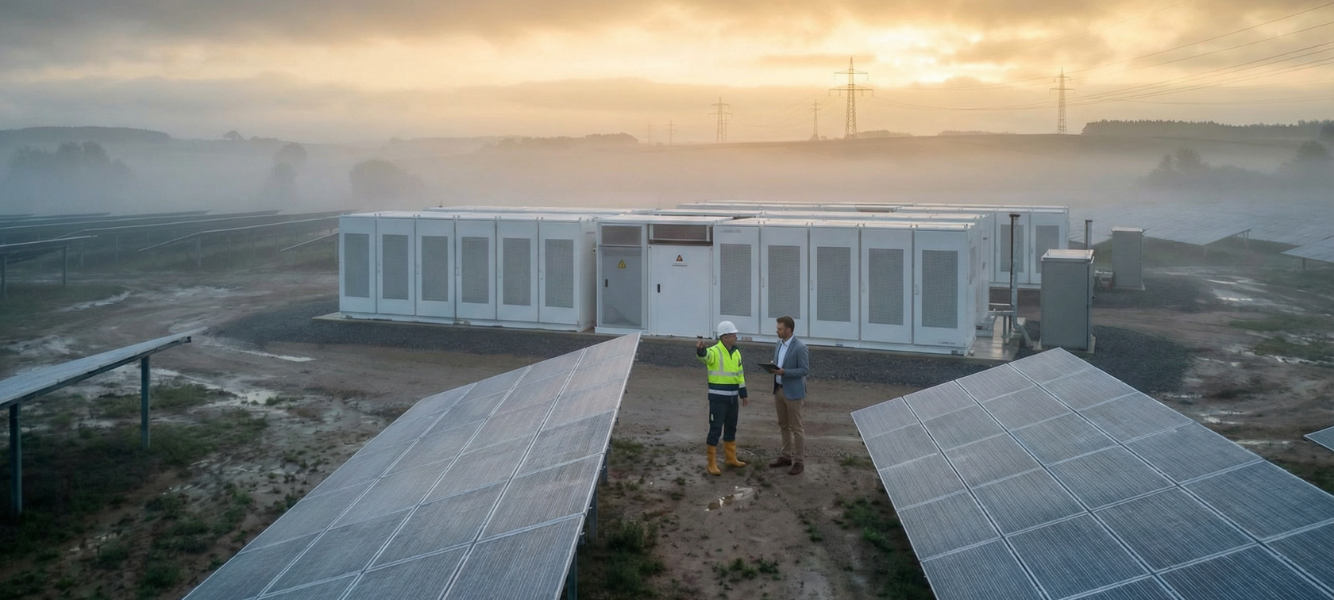



The week ending 30 January brought a flurry of Renewable news in the form of policy shifts and commercial signals that will reshape how UK renewable projects are financed, connected, and operated.
Government support for domestic solar and batteries made headlines, but beneath that, network planning, grid connection costs, and new tolling structures signalled where capital and capability will flow next.
This recap cuts through the noise to focus on what changed, what it means for developers and operators, and where hiring pressure is building across solar, BESS, AD, CHP, and EV.
The Big Signals This Week
-
Domestic solar and storage just became a volume game: the Warm Homes Plan commits £15 billion to finance 5 million home upgrades by 2030. Installers, supply chains, and consumer protection teams need to scale fast.
-
Biomethane connections no longer punish the first mover: Cadent ditched the “first connector pays” model. Shared reinforcement costs mean more AD projects can reach financial close.
-
BESS tolling deals are becoming bankable: Drax signed a ten-year contract for 250 MW without upfront capital. This opens a new financing pathway for utility-scale storage.
-
Heat networks became regulated utilities: Ofgem now licenses operators from 27 January. Compliance, metering, and consumer protection roles just became mandatory.
-
RO indexation switched from RPI to CPI: revenue uplifts are lower from April 2026. Asset valuations and refinancing assumptions need updating.
Solar and Behind the Meter Storage
The Warm Homes Plan announced on 20 January commits £15 billion to upgrade 5 million homes by 2030, with solar panels and batteries front and centre. Zero-interest loans are being offered for able-to-pay households, while low-income families will receive fully funded packages.
The scheme deliberately tilts subsidies towards solar and batteries rather than insulation alone.
This matters because it transforms rooftop solar from a niche retrofit into standard home infrastructure.
Solar Energy UK confirmed the sector is ready to deliver, but volume will test installer capacity, supply chains, and consumer finance operations. MCS certification, customer service standards, and quality control will come under scrutiny as demand surges.
The scheme launches in phases through 2026 and 2027, giving supply chains time to ramp, but consumer interest is already spiking.
Watch for clarity on eligibility criteria, loan application processes, and how local authorities administer the £5 billion low-income budget in the coming weeks.
BESS and Flexibility
Drax signed a ten-year tolling agreement for a 250 MW (500 MWh) battery at West Burton with no upfront capital commitment.
Under the deal, Fidra Energy will build and maintain the asset, while Drax pays a fixed annual fee indexed to CPI and retains full dispatch rights and merchant revenues except Capacity Market payments.
Financial close depends on Fidra’s FID by Q3 2026, with commissioning targeted for 2028.
This structure matters because it separates construction risk from operational upside and proves that utilities will contract long-term capacity without owning steel.
For developers, it validates the tolling model as bankable. For operators and optimisers, it signals that dispatch expertise and trading capability are now core commercial assets.
Revenue visibility improves, but operators need live market analytics, grid constraint forecasting, and real-time optimisation capability to extract full value.
At the same time, NESO published its first transitional Regional Energy Strategic Plan (tRESP) on 30 January. This plan guides DNO investment decisions for 2028–33 and marks the start of regional, whole-system energy planning.
It affects where BESS projects can connect, where grid capacity exists, and where reinforcement spend will flow. Developers and grid consultants should cross-reference project pipelines against tRESP regional forecasts.
Watch for Fidra’s FID announcement and for DNO business plans referencing tRESP assumptions.
AD and Biomethane
Cadent launched the UK’s first cost-sharing model for biomethane grid entry reinforcement.
Until now, the first developer triggering network reinforcement paid the full cost, often killing otherwise viable projects. Under the new “cluster” approach, multiple developers share reinforcement costs, and a portion is spread across the wider customer base.
The entry reinforcement assessment window runs until 6 March 2026.
This changes project economics immediately.
Developers who shelved sites due to connection cost uncertainty can now revisit feasibility studies. Cadent aims to reach 20 TWh of biomethane across its four networks by 2035, up from around 4 TWh today.
That requires hundreds of new connections, and the new model removes the biggest financial barrier.
Ofgem’s Green Gas Support Scheme quarterly report published 28 January shows delivery pipeline growth, but connection bottlenecks have been the constraint. This week’s announcement unlocks that.
Watch for clustering applications submitted by early March and for site-specific connection cost estimates to drop significantly.
CHP and Heat Networks
Heat networks regulation went live on 27 January.
Ofgem now licenses all heat network operators, with deemed authorisation for existing operators until 26 January 2027. After that, licences must be applied for.
New consumer protection standards, metering requirements, and complaint procedures are now mandatory.
This matters because heat networks are now regulated utilities. Operators need compliance teams, customer service infrastructure, metering and billing systems, and regulatory reporting capability.
CHP assets feeding heat networks must align with new technical and commercial standards. For developers, it creates certainty around revenue protection and consumer obligations. For operators, it means immediate investment in regulatory capability.
The shift also opens the door for institutional investment in heat networks, as regulatory frameworks reduce operational and reputational risk. Expect procurement activity around metering, billing platforms, and consumer engagement tools.
Watch for Ofgem’s licensing guidance and for operators’ transition plans ahead of the January 2027 deadline.
EV Charging and Demand Signals
The UK needs to more than double its annual EV charger installations to meet government projections of 250,000 to 550,000 chargers by 2030.
Around 15,000 chargers were added in 2025, but the government estimates over 32,000 per year are needed just to hit the lower target. Rapid charger installations fell by nearly half last year.
At the same time, average new car discounts neared £6,000, driven partly by manufacturers trying to meet EV sales mandates.
More EVs on the road means more demand for charging infrastructure, but charger operators paused investment last year due to policy uncertainty.
This creates a gap.
Demand for EVs is rising due to discounting, but charger rollout is slowing. For site developers, fleet operators, and grid connection specialists, this is a clear signal: charging infrastructure procurement will accelerate in 2026.
Rural and regional areas lag behind, and government funding of £381 million for underserved areas will flow through local authorities.
Watch for local authority procurement frameworks and for charger operators announcing new site partnerships.
What This Means for Hiring
-
Domestic solar installers and project coordinators: the Warm Homes Plan will drive volume demand for MCS-certified installers, sales teams, and customer onboarding capability.
-
Grid and connections specialists: tRESP planning, biomethane clustering applications, and accelerated BESS connections all require grid consultants and DNO liaison expertise.
-
BESS commissioning and optimisation: tolling structures depend on operational performance. Asset optimisation, trading, and dispatch capability are now revenue-critical.
-
Compliance and regulatory affairs: heat networks regulation creates immediate demand for licensing, consumer protection, and metering compliance roles.
-
AD project development and feasibility: Cadent’s cost-sharing model reopens shelved projects. Development managers and techno-economic analysts will see renewed activity.
-
EV charging site acquisition and fleet electrification: the charger rollout gap is widening. Site developers, fleet transition managers, and depot planners are in demand.