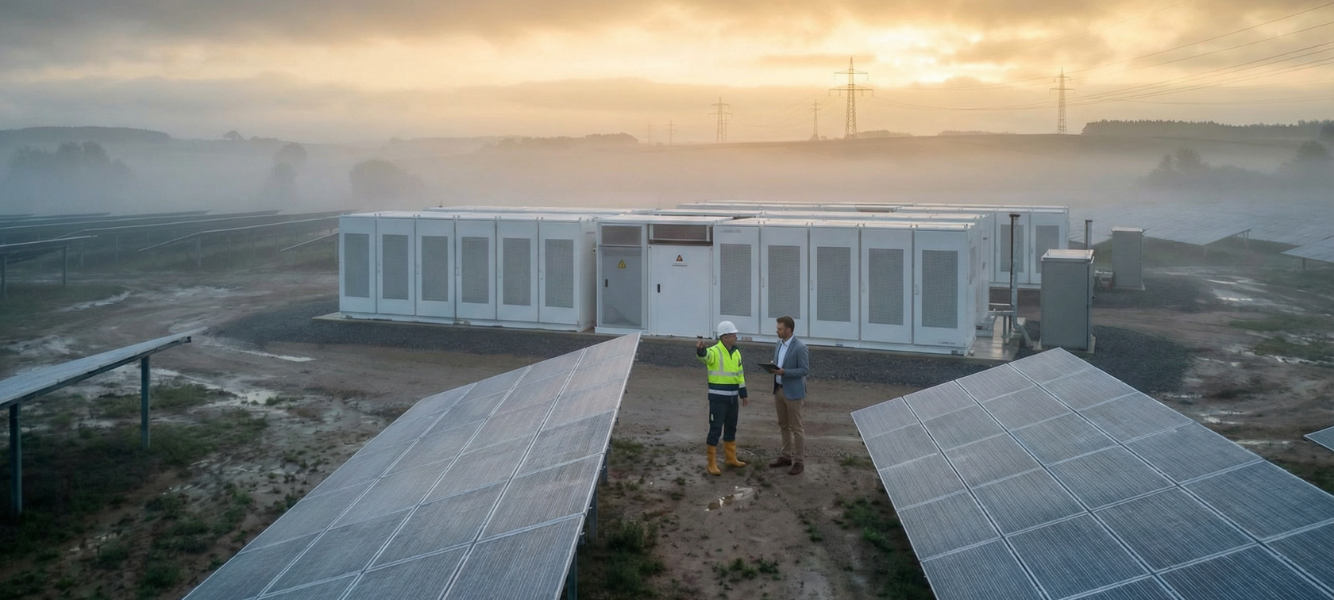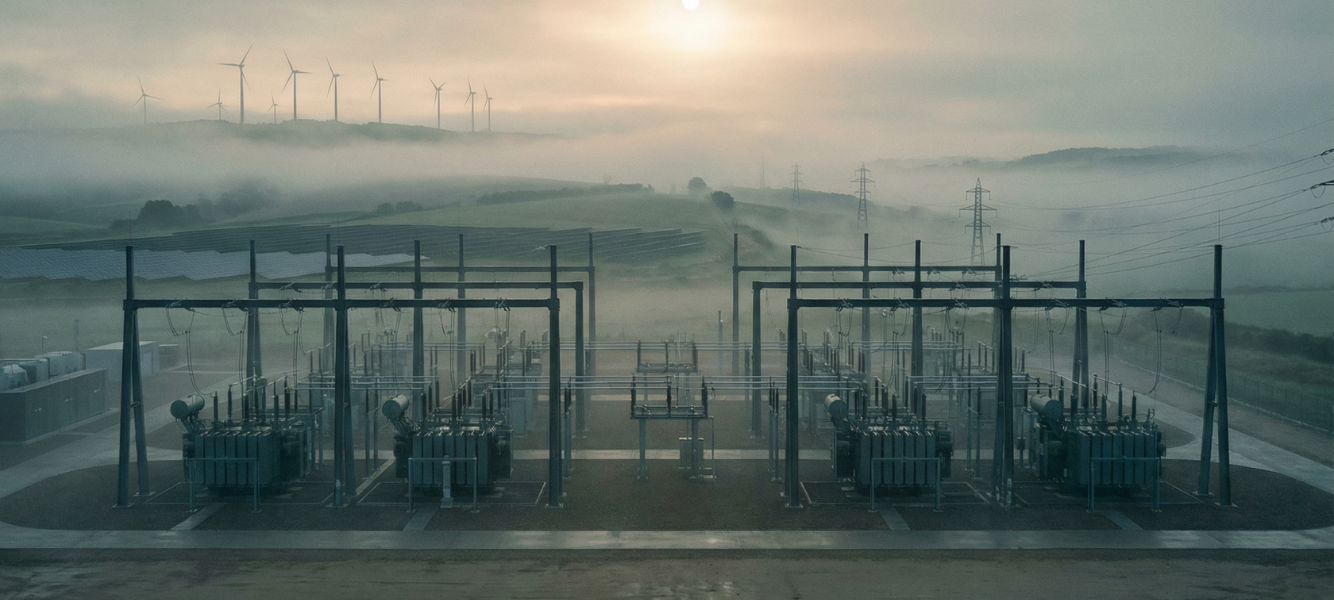


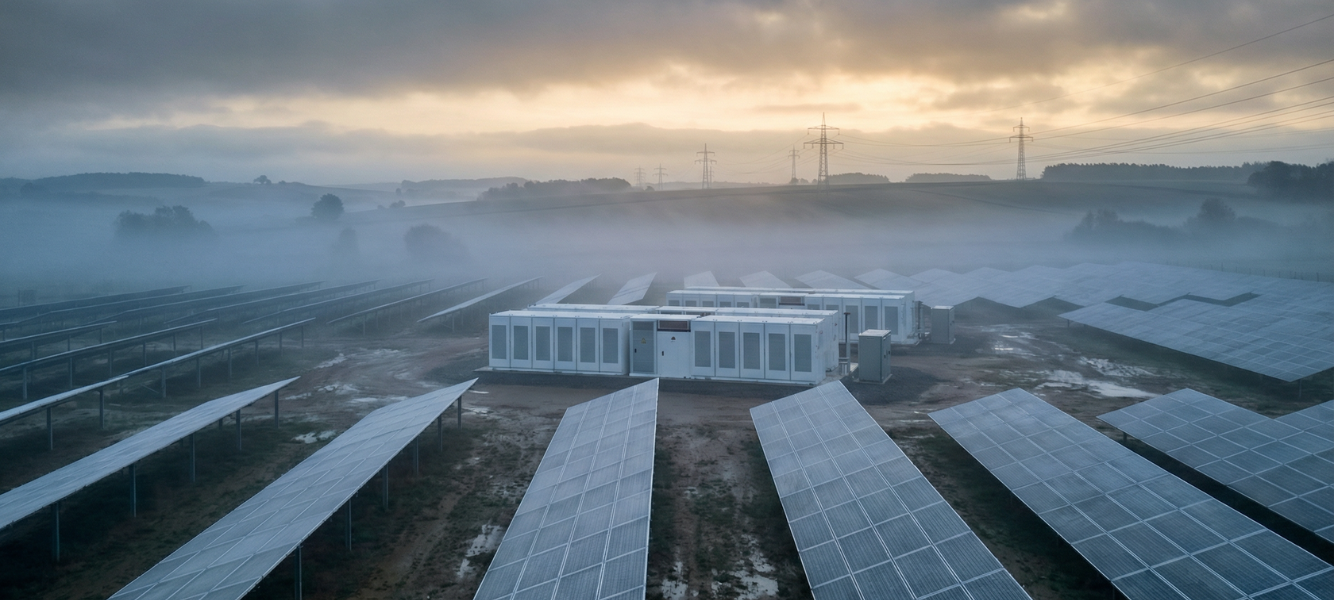
Solar plus storage pairs photovoltaic generation with battery systems on the same site, typically behind a shared grid connection.
It addresses renewable intermittency, unlocks multiple revenue streams, and enables solar projects to connect faster in congested grids.
What Is Solar Plus Storage?
Solar plus storage (also called co-located or hybrid solar-storage) describes projects where solar PV arrays and battery energy storage systems (BESS) are developed together, usually sharing infrastructure, land, and a single grid connection point.
The term emphasises operational integration rather than just physical proximity. The battery and solar are optimised together, not merely located on the same site.
This differs from standalone solar farms or batteries that connect independently.
It also differs from behind-the-meter residential systems, though the principle of storing surplus generation applies at all scales.
You’ll increasingly hear the term in commercial and utility-scale contexts where developers face grid constraints, curtailment offers, or complex revenue optimisation requirements.
How Solar Plus Storage Works
Core Components
A typical solar plus storage project comprises four main elements:
-
Solar PV arrays: Convert sunlight to DC electricity, typically oversized relative to the grid connection to maximise energy capture
-
Inverters: Convert DC to AC power (and vice versa for battery charging). Configuration determines whether the system is AC or DC coupled
-
Battery energy storage system (BESS): Stores electrical energy, usually lithium-ion chemistry, with capacity measured in MWh and power output in MW
-
Energy management system (EMS): Software that optimises when to charge, discharge, or export based on market prices, grid services contracts, and technical constraints
Energy Flow in Simple Terms
During sunny midday periods, solar panels generate electricity.
If generation exceeds the grid connection capacity or wholesale prices are low, surplus energy charges the battery rather than being curtailed.
The battery then discharges during evening peak demand when solar output falls and electricity prices typically spike.
The battery can also import cheap grid power overnight (unrelated to solar generation) and export during peaks, operating independently as an arbitrage asset whilst respecting any solar export priority rules.
Why Solar Plus Storage Matters Now
Solar deployment is accelerating in both the UK and US, but grid infrastructure is struggling to keep pace.
Developers face connection queues extending beyond 2030 and are offered curtailed connections where they can only export a fraction of their capacity.
Co-locating storage with solar provides three immediate advantages:
-
Faster grid access: A single connection for both assets bypasses the need to queue twice, potentially bringing projects forward by four years in the UK
-
Curtailment mitigation: Storage captures generation that would otherwise be wasted when the grid connection is at capacity, recovering lost revenue
-
Revenue diversification: Batteries access grid services markets (frequency response, capacity), reducing dependence on volatile wholesale electricity prices
National Grid has signalled the need for 23-27 GW of battery storage by 2030, roughly four times current UK capacity.
In the US, solar plus storage is the fastest-growing segment of the clean energy tax credit market, driven by the Inflation Reduction Act’s enhanced incentives.
Solar Plus Storage Revenue Models and Stacking
Revenue Stacking Explained
Revenue stacking means generating income from multiple market products simultaneously or sequentially from a single battery asset.
No single revenue stream alone typically justifies the capital cost of adding storage to solar, but combining several can transform project economics.
Typical revenue streams include:
-
Energy arbitrage: Charging when prices are low (including from solar) and discharging when high. In wholesale markets, intraday and real-time spreads often exceed day-ahead margins
-
Frequency response: Providing rapid power adjustments to maintain grid stability (UK: Dynamic Containment, Dynamic Regulation; US: frequency regulation in CAISO, ERCOT ancillary services)
-
Capacity payments: Being available to discharge during system stress periods (UK: Capacity Market; US: various capacity procurement mechanisms)
-
Curtailment avoidance: Capturing solar generation that would otherwise breach export limits, effectively converting constrained MWh into storable and time-shiftable energy
-
Grid services: Voltage support, black start capability, synthetic inertia in advanced applications
Constraints on Revenue Stacking
Revenue stacking has limits.
Key constraints include:
-
Availability requirements: Frequency response contracts often require the battery to maintain a minimum state of charge, limiting arbitrage opportunities
-
Cycling limits: Frequent charging and discharging accelerates battery degradation, shortening lifespan and reducing long-term profitability
-
Warranty terms: Manufacturer warranties typically cap annual throughput (e.g., 1.5-2.0 cycles per day), penalising aggressive use
-
Market rule conflicts: Some grid services prohibit simultaneous participation in energy markets or impose availability penalties
Research from University College London found that batteries can increase operating profits by 25% by delivering frequency response alongside arbitrage, capturing synergies between services.
However, sophisticated energy management systems and techno-economic modelling are essential to navigate trade-offs.
Grid Connections and the Curtailment Problem
Grid capacity is the defining constraint for many solar developers in 2026.
In the UK, developers report curtailment offers as high as 90-100%, meaning effectively zero export capacity, even for connection dates years away.
How Solar Plus Storage Changes Grid Value
Storage transforms the grid connection challenge:
-
Dynamic export management: Batteries absorb solar generation during constraint periods, allowing projects to accept higher curtailment offers in exchange for faster connection dates
-
Import-export flexibility: Batteries can charge from the grid during off-peak periods (when transmission capacity is available) and discharge during evening peaks, smoothing demand on constrained infrastructure
-
Reduced reinforcement requirements: Grid operators traditionally require network upgrades before connecting projects. National Grid now offers accelerated connections to storage projects on the condition that the system operator can curtail battery operation during peak constraint periods
In 2024, National Grid accelerated connections for 19 battery projects totalling 10 GW, with average acceleration of four years, by removing non-essential reinforcement requirements.
Many of these are co-located with solar or wind.
Interconnection Queues in the US
The US faces similar challenges.
Interconnection queues have lengthened significantly as wind, solar, and storage applications surge.
Co-locating storage with solar can streamline the process by requiring only one interconnection study and agreement, reducing costs and timeline.
Texas (ERCOT) has an accelerated interconnection process that has enabled rapid storage deployment alongside solar.
By Q2 2025, ERCOT briefly surpassed California (CAISO) in total installed battery capacity, demonstrating how regulatory efficiency can accelerate solar plus storage adoption.
Solar Plus Storage Policy Context: UK and US
UK Policy Environment
The UK government published its Solar Roadmap in 2025, targeting 45-47 GW of solar by 2030 (up from approximately 15 GW in 2024).
Key policy measures supporting solar plus storage include:
-
Planning reform: Storage sites above 50 MW no longer require national-level approval, allowing local authorities to grant consent more quickly
-
Zero VAT on battery storage: Applies to both new installations and retrofits alongside solar PV
-
Contracts for Difference (CfD): Recent AR6 auction awarded CfDs to co-located projects, though design complexity remains as solar typically receives export priority
-
Grid connection reform: National Grid’s five-point plan prioritises storage and hybrid projects for accelerated connections
The roadmap also supports rooftop and commercial solar deployment, with the top 20% of UK warehouses alone capable of hosting 15 GW.
US Policy Environment
The Inflation Reduction Act (IRA), passed in 2023, transformed US solar plus storage economics. Key provisions include:
-
Investment Tax Credit (ITC): 30% credit for solar and battery storage through 2032, stepping down to 26% in 2033 and 22% in 2034
-
Standalone storage qualification: Batteries now qualify for the full ITC independently of solar, though most developers still co-locate for operational synergies
-
Adders for low-income and energy communities: Additional 10-20% credits available for projects in qualifying locations
-
Transferable tax credits: Developers can sell tax credits to investors, creating a liquid market that has grown robustly through 2025
Congressional amendments in 2025 introduced placed-in-service deadlines for solar and wind beginning construction after mid-2026, though storage remains exempt. This creates an incentive to prioritise co-located projects that can claim credits for both technologies.
Design Choices in Solar Plus Storage Projects
AC Coupled vs DC Coupled Configuration
The choice between AC and DC coupling affects efficiency, cost, flexibility, and operational complexity.
| Factor | AC Coupled | DC Coupled |
|---|---|---|
| Configuration | Battery and solar each have separate inverters, connected on AC side before grid | Battery and solar share a single inverter, battery connects on DC side |
| Round-trip efficiency | 85-90% (two conversion steps) | Up to 98% (single conversion) |
| Flexibility | Battery can import from grid and operate independently of solar | Battery cannot import from grid; depends on solar generation |
| Retrofitting | Easier to add battery to existing solar site | Requires replacing inverter, more complex |
| Capital cost | Higher (two inverters) | Lower (one inverter) |
| Grid services | Full access to arbitrage and frequency response | Limited by inverter capacity constraint |
AC coupling is the most common method for utility-scale projects because operational flexibility typically outweighs the efficiency penalty.
The Bramley project in Hampshire uses an AC-coupled configuration, enabling the battery to charge from the grid overnight and manage solar export priority dynamically.
Storage Duration and Sizing
Duration refers to how many hours a battery can discharge at full power (e.g., 100 MW / 200 MWh = 2-hour duration).
Most utility-scale solar plus storage projects use 1-4 hour duration batteries:
-
1-2 hours: Suited to frequency response and short arbitrage windows
-
2-4 hours: Balances evening peak coverage with capital cost
-
4+ hours: Required for longer dispatch periods but significantly higher cost per MWh
Developers often oversize solar capacity relative to the grid connection (e.g., 70 MWp solar with 50 MW connection) to maximise energy yield despite clipping losses.
The battery captures clipped generation that would otherwise be wasted.
Safety, Degradation, and Siting
Fire safety is a critical design consideration.
Lithium-ion batteries can experience thermal runaway, generating toxic gases and fires that are extremely difficult to extinguish.
Modern projects incorporate:
-
Automatic fire detection and suppression systems (water misting recommended)
-
Physical separation between battery containers to prevent thermal propagation
-
Siting that accounts for prevailing wind direction to minimise community impact from potential toxic fumes
Battery degradation reduces capacity over time, typically 1-3% annually depending on cycling intensity and thermal management.
Project financial models must account for declining performance over 10-15 year operational periods.
Safety standards vary by jurisdiction but typically reference IEC, UL, or NFPA codes for electrical systems, fire protection, and grid interconnection.
Common Misconceptions About Solar Plus Storage
“Storage makes solar baseload power”
Battery duration is typically 1-4 hours, sufficient to shift solar generation to evening peaks but nowhere near the continuous multi-day operation required for baseload.
Storage provides peaking capacity and grid flexibility instead.
“Batteries always improve solar project economics”
In markets with flat power prices, limited grid services markets, or low curtailment, the capital cost of storage may not be justified by incremental revenues.
Revenue stacking opportunities and grid constraints drive the business case.
“DC coupling is always better because it’s more efficient”
Efficiency is one factor among many.
AC coupling’s operational flexibility (enabling grid charging, independent optimisation, and easier retrofitting) often provides greater long-term value despite lower round-trip efficiency.
Key Risks of Solar Plus Storage
Fire and safety: Thermal runaway incidents, though rare, can have catastrophic consequences. Robust safety systems and emergency response planning are essential.
Supply chain concentration: Battery manufacturing is dominated by a small number of suppliers (CATL, BYD, LG, Samsung). Supply chain disruptions or geopolitical tensions can delay projects or increase costs.
Regulatory and market rule changes: Grid services markets are evolving rapidly. Rule changes, price cannibalisation as more storage enters markets, and shifting capacity procurement mechanisms create revenue uncertainty.
Permitting complexity: Adding storage to solar projects introduces additional planning considerations, including fire safety assessments, noise from cooling systems, and community consultation.
Technology warranties and cycling limits: Aggressive revenue stacking strategies that maximise short-term income can void warranties or accelerate degradation, reducing long-term asset value.
Solar Plus Storage Project Timeline
A typical utility-scale solar plus storage project in the UK or US takes 2-4 years from site selection to commercial operation.
Key phases include:
-
Site selection and feasibility (2-4 months): Assess solar resource, grid connection proximity, land availability, planning constraints, and initial commercial viability
-
Land acquisition (3-6 months): Secure site control via purchase, lease, or option agreement with landowner
-
Grid connection application (6-18 months): Submit connection request to distribution or transmission operator, receive connection offer outlining capacity, costs, and timeline. This is often the longest and most uncertain phase
-
Planning consent (6-12 months UK; varies by state in US): Prepare and submit planning application, address consultee comments, attend planning committee if required. Storage components require additional safety and fire risk assessments
-
Financing and contracts (3-6 months): Secure debt and equity, negotiate power purchase agreements (PPAs), grid services contracts, EPC contracts, and O&M agreements
-
Procurement (3-6 months): Order long-lead items including solar modules, inverters, transformers, battery containers, and balance of plant equipment
-
Construction (9-18 months): Site preparation, civil works, installation of solar arrays and battery systems, electrical works, grid connection commissioning
-
Testing and commissioning (1-3 months): Factory acceptance tests, site acceptance tests, witness tests with grid operator, software integration and EMS tuning
-
Commercial operation: Handover to asset manager and optimiser for ongoing operation
Delays are common at grid connection and planning stages.
Co-location can accelerate timelines by requiring only one connection agreement rather than separate applications for solar and storage.
Real World Solar Plus Storage Projects
Bramley, Hampshire, UK
Location: Tadley, Hampshire (57 MW BESS + 49.9 MW solar PV)
This flagship UK project combines a 57 MW, 2-hour battery (114 MWh capacity) with 49.9 MW of solar in an AC-coupled configuration sharing a 57 MW transmission connection.
The solar array secured a Contract for Difference in the AR6 auction, with export priority over the battery. The battery dynamically adapts to solar generation, charging from clipped solar output and grid imports, then discharging during evening peaks.
Annual expected generation of 60,000 MWh will power over 22,000 households. The project demonstrates successful co-optimisation, not just co-location, with EDF providing optimisation services.
It was developed by Enso Energy, sponsored by Cero Generation, with Sungrow supplying PowerTitan 2.0 liquid-cooled storage systems.
Oasis de Atacama, Chile
Location: Atacama Desert, Chile (11 GWh storage + 2 GW solar)
Grenergy’s Oasis de Atacama is set to become one of the world’s largest solar plus storage projects, featuring 11 GWh of battery capacity paired with 2 GW of photovoltaic generation.
The project is being developed in seven phases, with Phase 1 achieving grid connection in 2024 and remaining phases in 2025.
Once complete, it will deliver approximately 5.5 TWh of energy annually, shifting solar generation into evening and night hours to stabilise Chile’s power system.
BYD is supplying 1.1 GWh of battery systems under its MC Cube ESS model, whilst CATL is contracted to deliver 1.25 GWh for phase four. The project illustrates how storage enables solar deployment in regions with evening demand peaks misaligned with daytime generation.
Saudi Arabia Grid-Scale Storage
Location: Najran, Madaya, and Khamis Mushait (7.8 GWh total storage)
Sungrow is delivering 7.8 GWh of grid-scale storage capacity across three sites in Saudi Arabia, each hosting 2.6 GWh.
Whilst not exclusively paired with solar, the project is designed to support the Kingdom’s renewable energy expansion, absorbing daytime solar generation and discharging during evening peaks.
More than 1,500 PowerTitan 2.0 liquid-cooled storage units are being deployed, featuring grid-forming and black start capabilities. Equipment deliveries began in 2024, with full grid connection expected during 2025.
The project demonstrates storage deployment at scale to enable solar integration in high-growth markets.
Port of Hull Rooftop Solar, UK
Location: Port of Hull, East Yorkshire (6.5 MW rooftop solar)
Custom Solar installed the UK’s largest rooftop photovoltaic system at the Port of Hull, comprising 21,000 panels across major terminal buildings.
The 6.5 MW installation enables the port to power itself during peak generation periods and slashes carbon dioxide emissions by almost 3,000 tonnes annually.
Whilst this project doesn’t currently include battery storage, it illustrates the scale of commercial rooftop solar opportunities identified in the UK Solar Roadmap, with potential for future battery integration to manage export and self-consumption.
Aberdeenshire Council Social Housing, UK
Location: Aberdeenshire, Scotland (500 homes with solar plus storage)
Emtec Energy secured a groundbreaking contract in 2019 to install solar PV and battery storage across 500 council homes.
The project aimed to alleviate grid constraints, provide clean energy to tenants, reduce fuel poverty, and generate income for the council.
Importantly, the project set a precedent by aggregating the distributed solar and battery systems to deliver grid services, demonstrating revenue stacking at residential scale. This model shows how solar plus storage can address multiple social and economic objectives simultaneously.
Texas and California Market Context
ERCOT (Texas): Storage capacity increased from 363 MW in 2019 to 9,863 MW by end of 2024, a 2,617% increase.
Solar generation rose 996% in the same period. On Texas’s record peak summer day in 2024, solar and storage provided critical capacity, with storage enabled by solar generation earlier in the day.
ERCOT’s accelerated interconnection process has driven rapid solar plus storage deployment.
CAISO (California): California has 13,250 MW of installed grid-scale battery storage as of June 2025, nearly triple 2023 levels.
The state projects needing 58,000 MW of storage by 2045 to support renewable expansion under SB100. California pioneered large-scale battery integration with the grid, proving technical and commercial viability that has now been replicated globally.
Skills and Jobs in Solar Plus Storage
The rapid growth of solar plus storage is creating demand for specialised roles across the project lifecycle.
Key job categories include:
Development and origination: Project developers who secure sites, manage grid applications, and navigate planning; commercial analysts who model revenue stacking; land acquisition specialists.
Grid and electrical engineering: Grid connection specialists who liaise with transmission and distribution operators; electrical engineers who design power systems, protection coordination, and utility interconnection; power electronics engineers focused on inverters and converters.
Battery systems engineering: Battery systems engineers who design cell selection, pack architecture, thermal management, and safety protocols; software developers building battery management systems (BMS) and state-of-charge algorithms.
Energy trading and optimisation: Energy traders and optimisers who manage revenue stacking across wholesale, balancing, and ancillary services markets; data analysts who forecast prices and develop bidding strategies.
Construction and commissioning: Construction project managers with renewables experience; commissioning engineers who oversee testing, energisation, and handover; electrical installation technicians.
Operations and asset management: O&M managers responsible for ongoing performance; asset managers who oversee commercial operations; performance analysts monitoring degradation and availability.
Safety and compliance: Safety specialists with BESS expertise, particularly fire risk assessment and emergency response; compliance managers ensuring adherence to grid codes, planning conditions, and environmental permits.
Required skills include proficiency in electrical engineering, familiarity with grid codes and interconnection standards, experience with simulation tools (MATLAB/Simulink), understanding of battery chemistry and degradation, and increasingly, software development skills for EMS and SCADA systems.
The sector values candidates who combine technical depth with commercial awareness, particularly understanding of revenue stacking and market mechanisms.
10 Key Takeaways
-
Solar plus storage pairs PV generation with batteries behind a shared grid connection, enabling revenue stacking, curtailment reduction, and faster grid access compared to standalone assets
-
Revenue stacking combines energy arbitrage, frequency response, capacity payments, and curtailment avoidance, but must respect constraints like availability requirements, cycling limits, and warranty terms
-
AC-coupled configurations (85-90% efficiency) dominate utility-scale projects because operational flexibility typically outweighs the efficiency advantage of DC coupling (up to 98%)
-
Grid connection queues and curtailment offers are the defining constraints for solar developers in 2026; co-locating storage can accelerate connections by four years in the UK
-
The UK targets 23-27 GW of battery storage by 2030, whilst the US IRA provides 30% ITC for solar plus storage through 2032, with additional adders for low-income areas
-
Fire safety is critical. Lithium-ion batteries can experience thermal runaway producing toxic gases and fires that are extremely difficult to extinguish, requiring automatic suppression systems and physical separation
-
Battery duration is typically 1-4 hours, sufficient for shifting generation to evening peaks but not for the continuous multi-day operation that baseload requires
-
Real-world projects like Bramley (UK: 57 MW BESS + 49.9 MW solar) and Oasis de Atacama (Chile: 11 GWh + 2 GW solar) demonstrate technical and commercial viability at scale
-
Project timelines typically span 2-4 years from site selection to commissioning, with grid connection and planning being the longest and most uncertain phases
-
High-demand jobs include project developers, grid connection specialists, battery systems engineers, energy traders/optimisers, commissioning engineers, and safety specialists with BESS expertise
References
- EDF Energy. (2025). The power of co-location: Accelerating an integrated energy system.
- UK Government Department for Energy Security and Net Zero. (2025). Solar Roadmap: United Kingdom powered by solar.
- Alternergy. (2025). UK Solar Roadmap 2025: Key Government Actions.
- Lumify Energy. (2025). Solar Battery Storage in the UK: A Detailed Guide.
- Apatura Energy. (2024). The Latest Action to Cut BESS Connection Backlogs in the UK.
- Solar Energy UK. (2024). MPs to be told grid delays are descending into farce.
- National Fire Chiefs Council. (2025). Battery Energy Storage Systems (BESS) Position Statement.
- Devon & Wiltshire Fire and Rescue Service. (2025). Battery Energy Storage Systems (BESS).
- Modo Energy. (2023). Co-location of battery energy storage: AC/DC coupling.
- Macquarie Asset Management. (2025). Battery storage: Strategies for revenue stacking and business models.
- Pusceddu, E. et al. (2021). Synergies between energy arbitrage and fast frequency response for battery energy storage systems. UCL Discovery.
- PV Tech. (2026). Solar-plus-storage and policy to drive investment tax credit trends in 2026.
- Clean Energy Group. (2025). What Nonprofits Need to Know about the Investment Tax Credit.
- White & Case. (2025). New law changes IRA Tax Credits.
- Solar Energy UK. (2025). Solar and battery storage sector’s best projects showcased.
- Solar Power Portal. (2023). Sungrow to provide 100MW of energy storage to Hampshire.
- Renewable Energy Magazine. (2023). Bramley battery storage project in Hampshire awarded planning approval.
- BlackRidge Research. (2025). Top 5 Largest Upcoming BESS Projects in the World 2025.
- Resources for the Future. (2025). Charging Up: The State of Utility-Scale Electricity Storage in the United States.
- Amperon. (2025). Battery Energy Storage: ERCOT vs. CAISO.
- US Department of Energy. (2025). ERCOT and CAISO Demonstrate System Reliability with Renewable Energy and Storage. Federal Energy Regulatory Commission analysis.
- ARM Recruitment. (2025). Solar and BESS (Battery and Energy Storage Solutions) Recruitment.
- Enable Green. (2025). BESS Development Director Solar and Battery Developer Job Description.
- ESZone. (2025). Jobs in Energy Storage: High-Demand Roles, Skills, and Career Paths for 2025 and Beyond.